

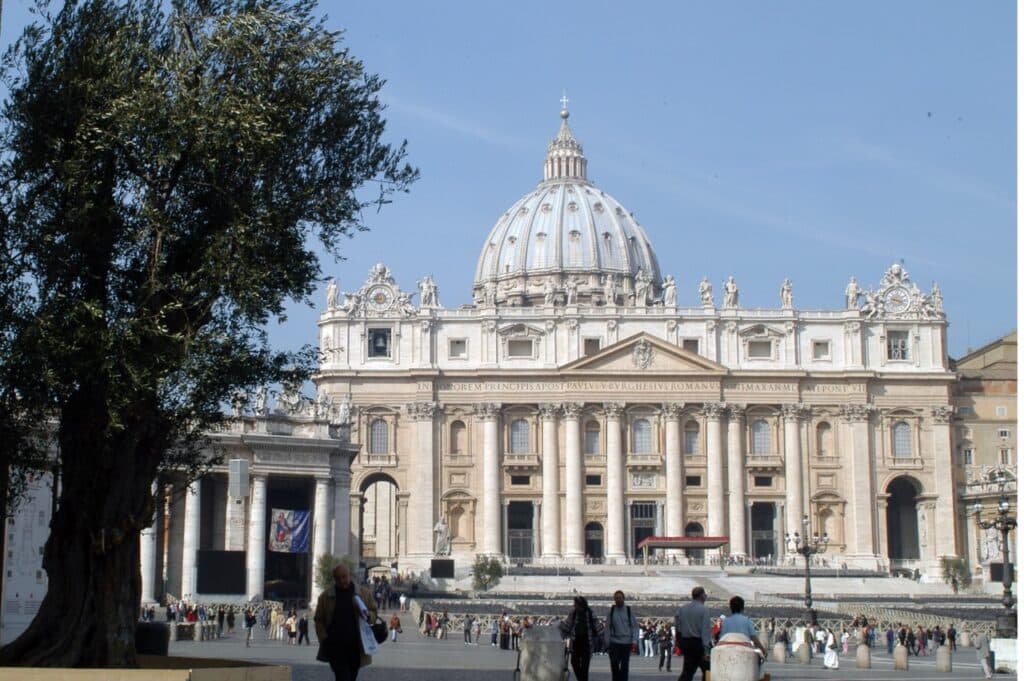
Your days in Rome can be some of the most important in your life. In fact, they can change your life. We at St. Patrick’s want to introduce you to the idea of pilgrimage. From the most ancient of times, men and women have chosen to become pilgrims. They have left their homes and the structures of their ordinary lives and made a very special journey – a journey toward the holy. It was a chance to step away from the known and the familiar – from their families, their homes and their work – in order to experience conversion or change of heart. The journey of Abraham and Sarah in the book of Genesis, that of Moses in the wilderness driven out by the Pharoah and again when he led his people back to Sinai, that of the prophet Elijah in the desert, and when Jesus entered into the wilderness for 40 days and 40 nights, are all examples of pilgrimage. Christians made the first pilgrimages in the Third Century. They came in numbers to Jerusalem to follow in the footsteps of Jesus and to Rome to visit the tombs of the Apostles Peter and Paul and the martyrs. You now do the same thing.
Pilgrimage begins with the idea that at some time each of us needs to get away. The world in which each of us lives, our homes and our jobs have a profound effect upon us, and there are moments when we simply need to leave them, if only for a little while, in order to put our lives back into focus. How many times have you said, “If I could only have a day off,” or “If only I could have peace and quiet.” Pilgrimage is the chance to do something very different from what we do during the rest of our lives. It is a chance to make a journey toward the Holy. It is a chance to look at our lives by stepping back and stepping away and looking at them in the light of God’s presence. And it is a chance, being very far away from work and home, to make some decision, to decide to change your hearts, to change your lives, to re-consecrate yourselves to God again. Such opportunities rarely happen in our lives. Pilgrims have been coming to Rome in groups since the 4th Century when Constantine made Christianity the religion of his Empire and built great shrines to God in Rome and Jerusalem. Here in Rome he built two great churches over the graves of the Apostles Peter and Paul. In time, other shrines and churches would be built to the Roman martyrs. These are holy places and if you visit them as pilgrims, extraordinary things can happen.
It was once possible to distinguish between a “tourist” and a “pilgrim.” A tourist was a traveler who sought to replicate in a foreign land as much of his or her own world as possible. Guides (persons or books) translated what they encountered into the familiar. Recognizable food and other creature comforts and, most importantly, photographs and souvenirs to provide a means to fondly remember the trip. These were meant to soften the hardship of travel and make the journey as comfortable as possible. A pilgrim, by distinction, was a traveler in search of something outside of the familiar. Pilgrimage is a journey into the unknown. The beginning of pilgrimage is to place oneself into the hands of God. Through this act of faith, a pilgrim goes in search of the holy away from the structures of everyday life. This could be dangerous and was often uncomfortable, but somehow the danger and discomfort were a part of the spiritual journey. For early and medieval Christians, to make a single pilgrimage in one’s lifetime was considered a great religious accomplishment, as it still is today for Moslems who journey to Mecca. For western Christians, the comforts of tourism serve as an obstruction and can obscure or prevent the dynamics of pilgrimage from taking place.
Today, between tourist and pilgrim, is a new category of traveler, the “religious tourist.” This is someone who comes to Rome for a religious purpose but does not know how to achieve their spiritual goal. To be a Catholic and come to the city of the apostles and walk in the places of martyrs, mystics and saints, it is quite reasonable to expect to experience something of the Holy. While the expectation is authentic, sadly, the tools and opportunities for such an experience are few. Surrounded by professional travel consultants, bus schedules, group dinners, and frozen itineraries, you can miss and be hurried past the spiritual richness of Rome. I want to suggest some ways to make sure this is a pilgrimage for you and not a religious tour:
What is the goal of your Pilgrimage? A pilgrimage is a special spiritual journey towards. The holy with the hope of personal and spiritual transformation. But all transformations take specific form. What is the goal of your pilgrimage? What at of your life do you wish God to touch on this journey? What questions do you bring with you? Is this a personal journey for healing? If so, then what in you needs healing? Are you seeking to make a decision when this pilgrimage is over? Do you seek to heal a relationship? Is there someone you have brought with you in prayer, perhaps a family member or friend? What is your hope for them? You cannot begin your pilgrimage if you do not know why you have come.
Identifying yourself as Pilgrim. From the most ancient of times, pilgrims have traveled in distinctive garb, with a pilgrim staff and with letters of identification. In the past, few people traveled far from home, therefore pilgrims were strangers as they passed through villages and towns. The fact that they were recognized as pilgrims gave them shelter and protection. Find something that you can wear as a sign of your pilgrim identity, perhaps a cross on a chain or a small religious pin. A scarf or hat is something to which you can add small pins that you can collect along the way that mark your journey. It is amazing how wearing such items or touching them at times of stress will remind you that you are a pilgrim. And remember, these items are blessed at each holy site or at the special liturgies you attend. There will be moments when you will forget that you are on a special journey toward, such as the dynamics of travel, the inconsiderateness of others, the periods of waiting, etc. So having something that you can hold onto will help return to a pilgrimage mentality. This is also something that you can bring back from your pilgrimage, and which will remind you weeks and months from now about your special journey to Rome.
A Pilgrim Bag. Fix a pilgrim bag for yourself and find small items to add to this bag as you journey. You can find these things in almost any store in Rome. Add a small book of blank pages and a couple of pens to write down your thoughts, questions, impressions and prayers. If you did not bring a prayer book, a rosary or a small bible for your personal prayer, then you can pick one up in Rome and add it to your bag. And a small bag will allow you to collect items to remember your pilgrimage and to keep items that are the tools of pilgrimage, like the ancient pilgrim staff that helped pilgrims on their long journey. (Today such a staff might be difficult to bring with you on the plane.)
Learning the spiritual meaning of what you are seeing. Many times, people enter churches and other holy sites in Rome without ever learning about the spiritual history of these holy places. The first question to ask always is, “Why is this place holy?” A second question would be, “What are the stories of faith that can be found in these places?” And “How do these stories relate to the story of your life and your faith journey?
Visiting the Saints. While Jerusalem is a city built on holy stones such as the Mount of Olives, or the Church of the Holy Sepulcher, Rome is a city built on the bones of the Martyrs and Saints. The saints are everywhere in this city, from the early Roman martyrs to the great saints of the Catholic Reformation (such as Sts. Philip Neri, Catherine of Silena and Ignatius Loyola). Why not visit the saints during your pilgrimage and have a holy conversation in prayer with them? They would love to see you. There are so many saints buried in various churches in Rome. You can ask about their stories and take time to visit them. Many people do not know, for example, that the relics of St. Matthew and St. Jerome are buried in the main altar of St. Mary Major or that St. Timothy is buried next to St. Paul in his Basilica. In the Communion of Saints, we believe as Catholics that they continue to serve as our spiritual guides and friends.
Praying in the oddest places. If you do not make time for prayer, don’t always be certain that your guide will make that happen. Guides often seek to move you in and out of these places on a schedule, especially with increased traffic problems during a Jubilee Year. Ask if there will be a chance to pray, or to at least sit down for a few minutes, as you can use the time for personal prayer. Ask if the Blessed Sacrament is in a side chapel and if you can visit. Learn to pray on your feet. If you have brought a rosary, New Testament or journal, use it for prayer while you are waiting, in the spaces between your schedule, or on the bus between sites. Use the gaps in the schedule, while waiting to board the bus, or the restroom breaks to sit and pray.
Keeping a Pilgrim journal. Your immediate impressions, your thoughts about self and family, or perhaps that spontaneous moment of prayer may be the great gift of your journey. How will you remember these moments if you have not written them down. Perhaps you like to sketch an image, or jot down a poem, a phrase, inscription or quote you have seen. A pilgrim journal can be a tremendous spiritual tool for your journey toward the holy. And you might want to enclose something from home, such as a photo of someone with you who wish to share this pilgrimage. Take some time before you go be each night, or on the bus between sits, to reflect and write down your thoughts. Think of your journey as a great story between you and God and take time to write out the chapters.
Collecting Pieces of Your Pilgrimage. Some of the best images you will see are postcards, and they can be placed inside your pilgrim journal. But there are other less obvious items. A small, pressed flower or leaf or small pebble will bring back memories of a specific moment of your journey. Also most of the major basilicas have gift shops with small English language guides to the church. Some commentary after the fact will not only help you remember, but will deepen the perception of what experienced.
Preparing to Come Home. Just as you took time to prepare to begin your pilgrimage, you also need time to bring it to a close. The end of your pilgrimage should suggest a new beginning for yourself. If you are not a part of a group, be sure to find a place to celebrate a closing liturgy. Take your journal and your memories to this liturgy. Take time on your last day to reflect in prayer on what happened to you on this journey. Revisit the questions and issues you first raised. How have these days away helped give you new perspective into yourself and your life? If you have made some resolutions about what you seek to change or do differently upon your return home, then bring these with you to the closing liturgy. And remember, if you feel rushed throughout the last day, the long plane ride home is also an opportunity for reflection and prayer.
Home a Month. After you have been home for about a month, take a day to yourself and review your pilgrimage. By now the memories have begun to fade. Put your pilgrim cross or hat back on. Read your Pilgrim journal. Take time in prayer and reflect on what has happened to you in the last month. Look at the images that you brought back and examine any other memories you saved from the trip. What were your pilgrim issues or questions? What resolutions did you make at the end of your pilgrimage? What have you done over this last month to act on these things? Has your life changed? Have you found new beginnings? End your day by attending the Eucharist and giving thanks for your pilgrimage.